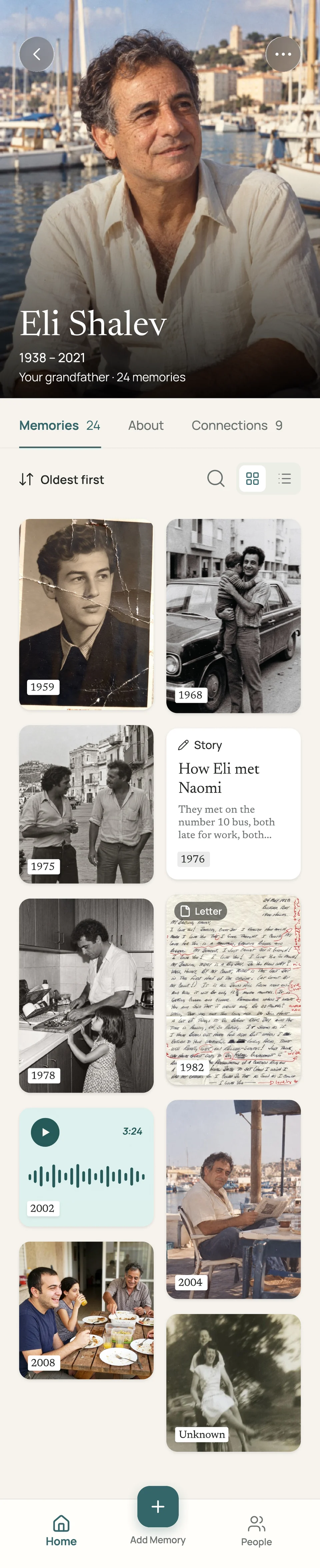

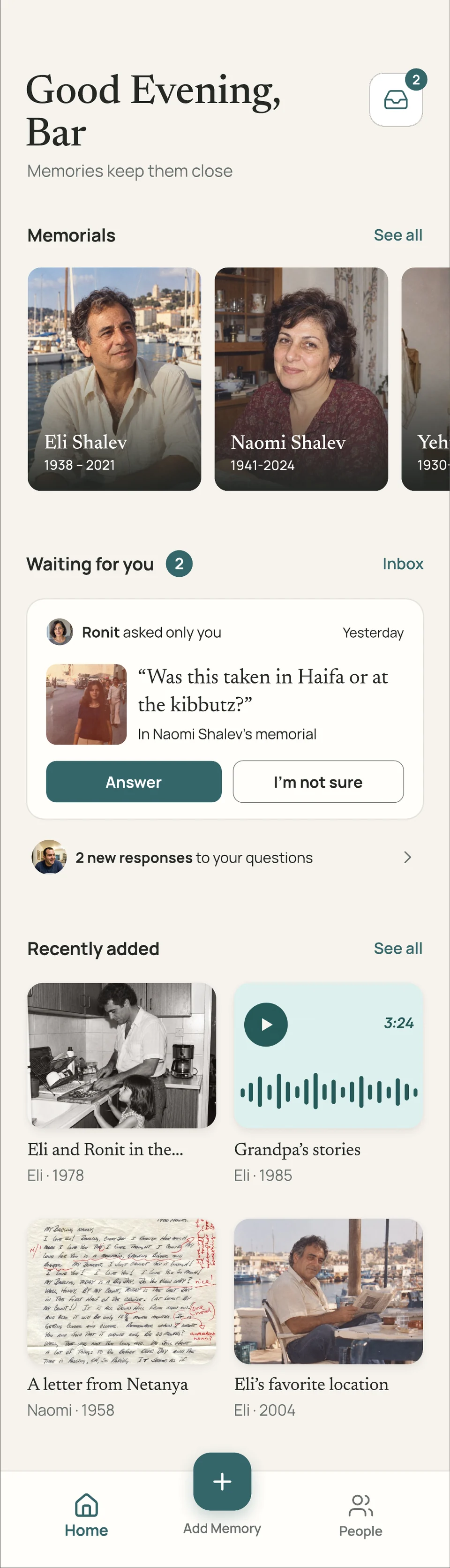
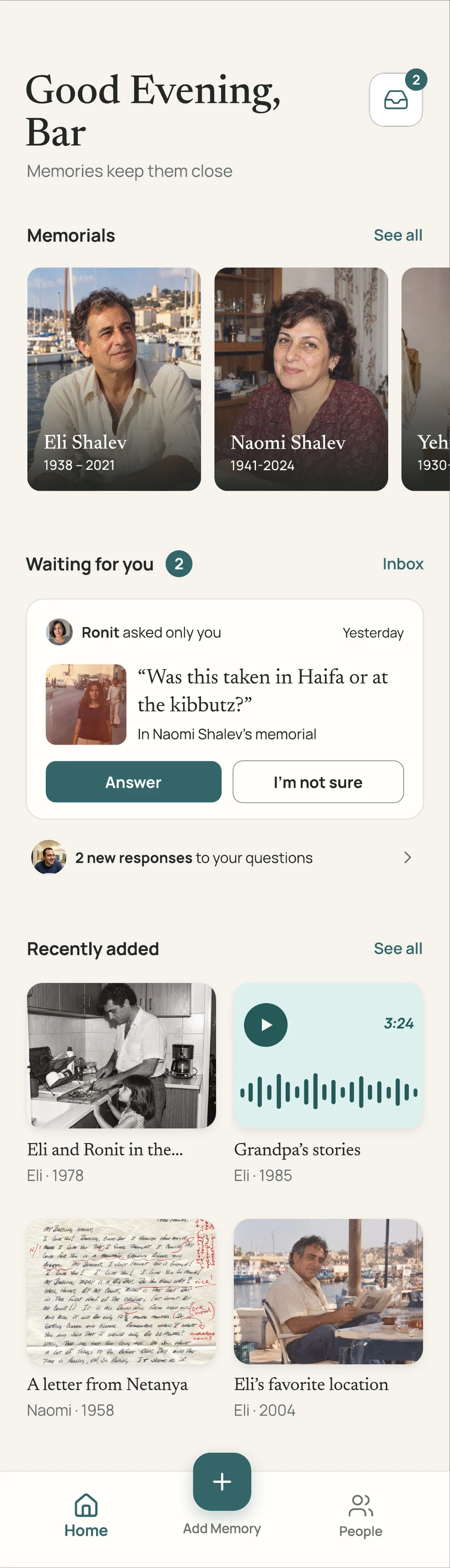
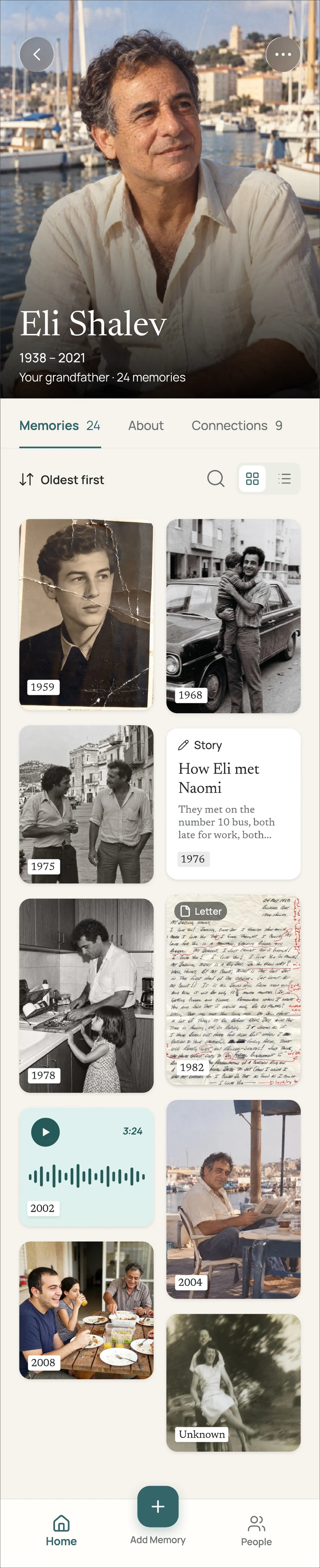

Animated screen preview
One memory, from unknown to known.
Seven final screens in sequence. A preview of the flow, not a working prototype.
- 01 Home
- 02 Eli's memorial
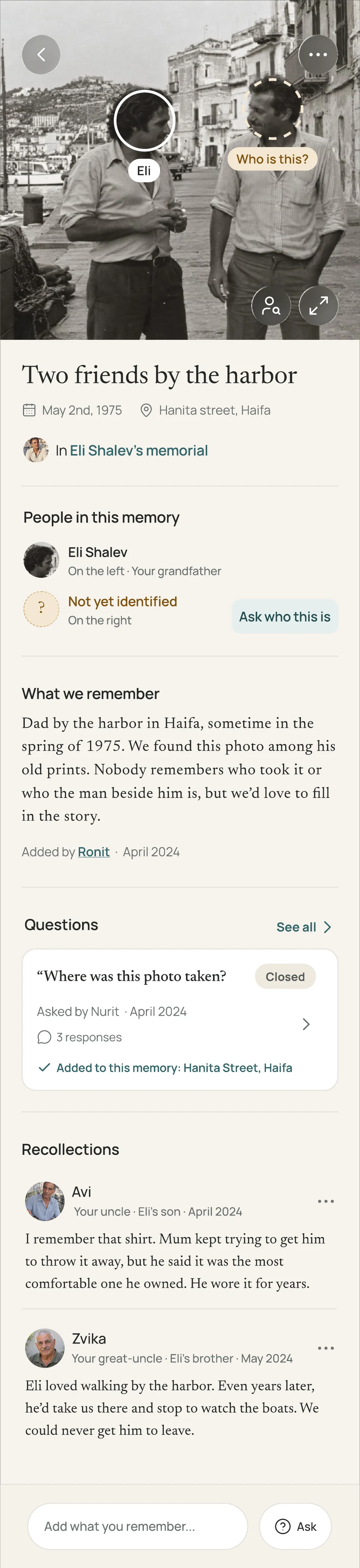
- 03 Unknown person
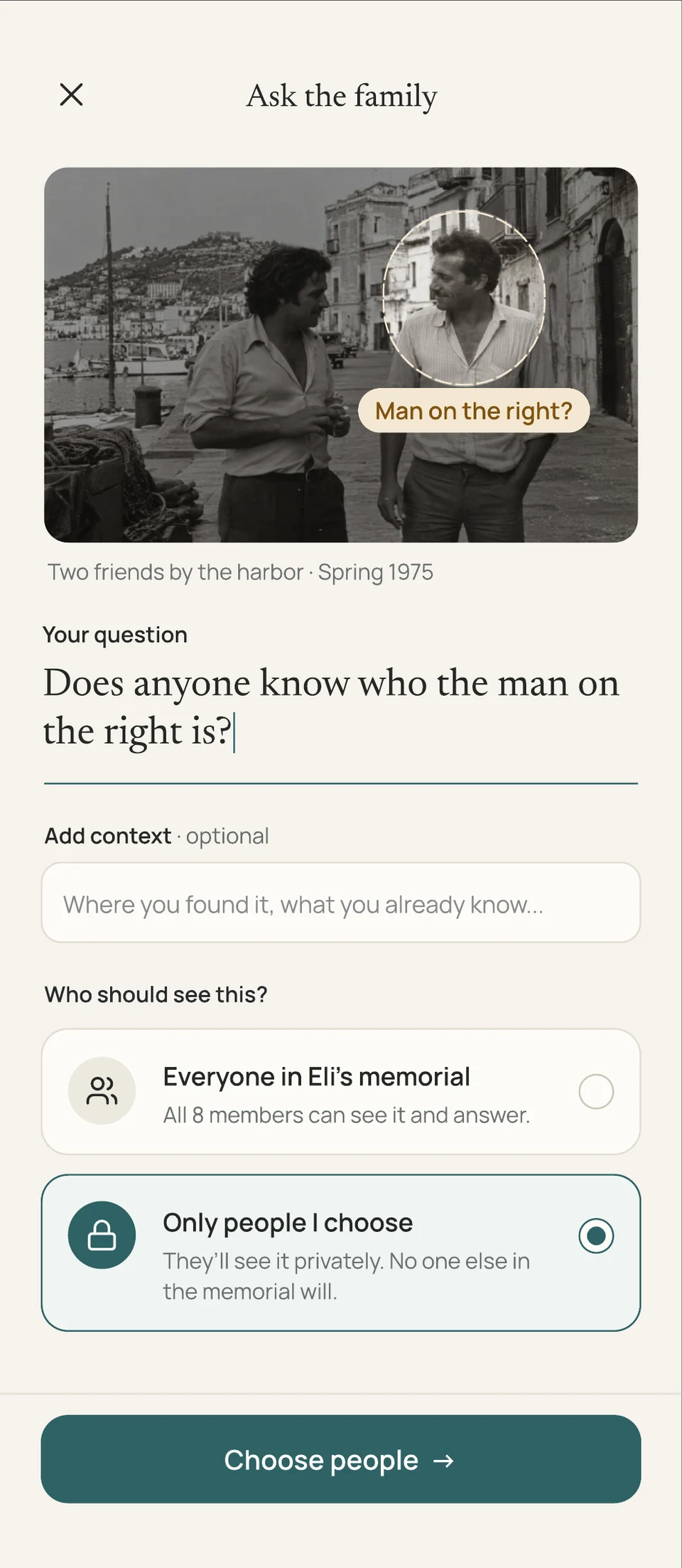
- 04 Ask the family
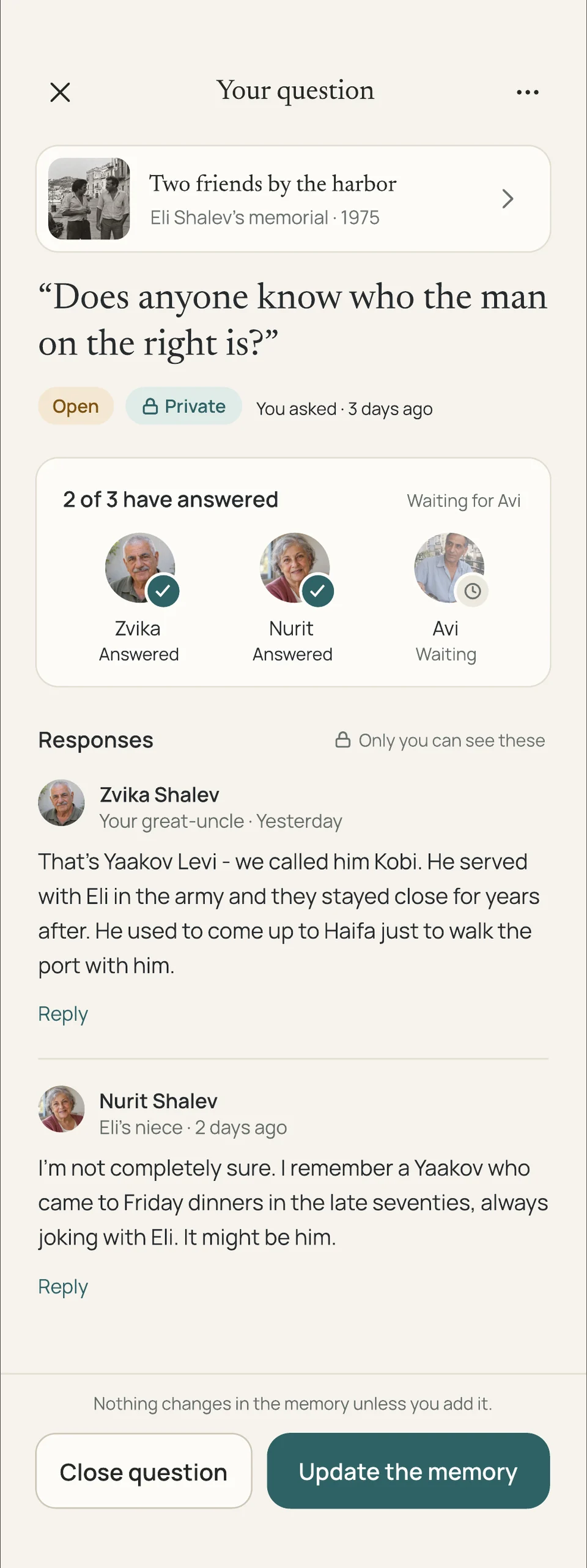
- 05 Perspectives
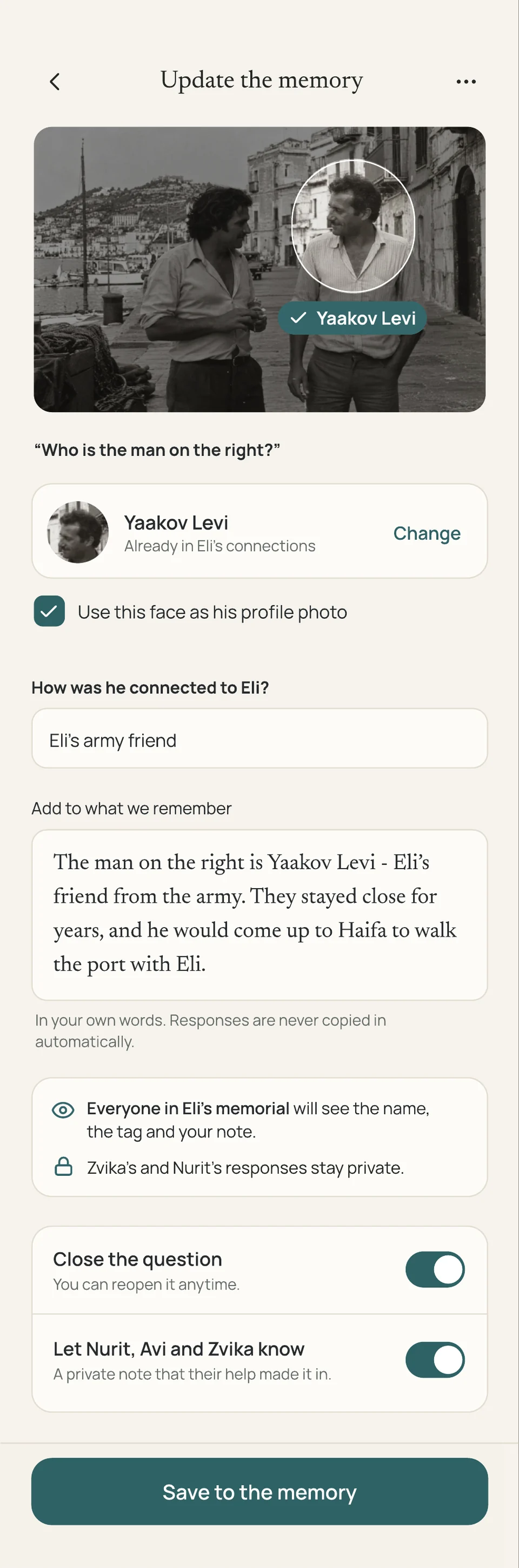
- 06 Update the memory
- 07 Yaakov Levi identified
(01) The problem
Photos survive.Context disappears.
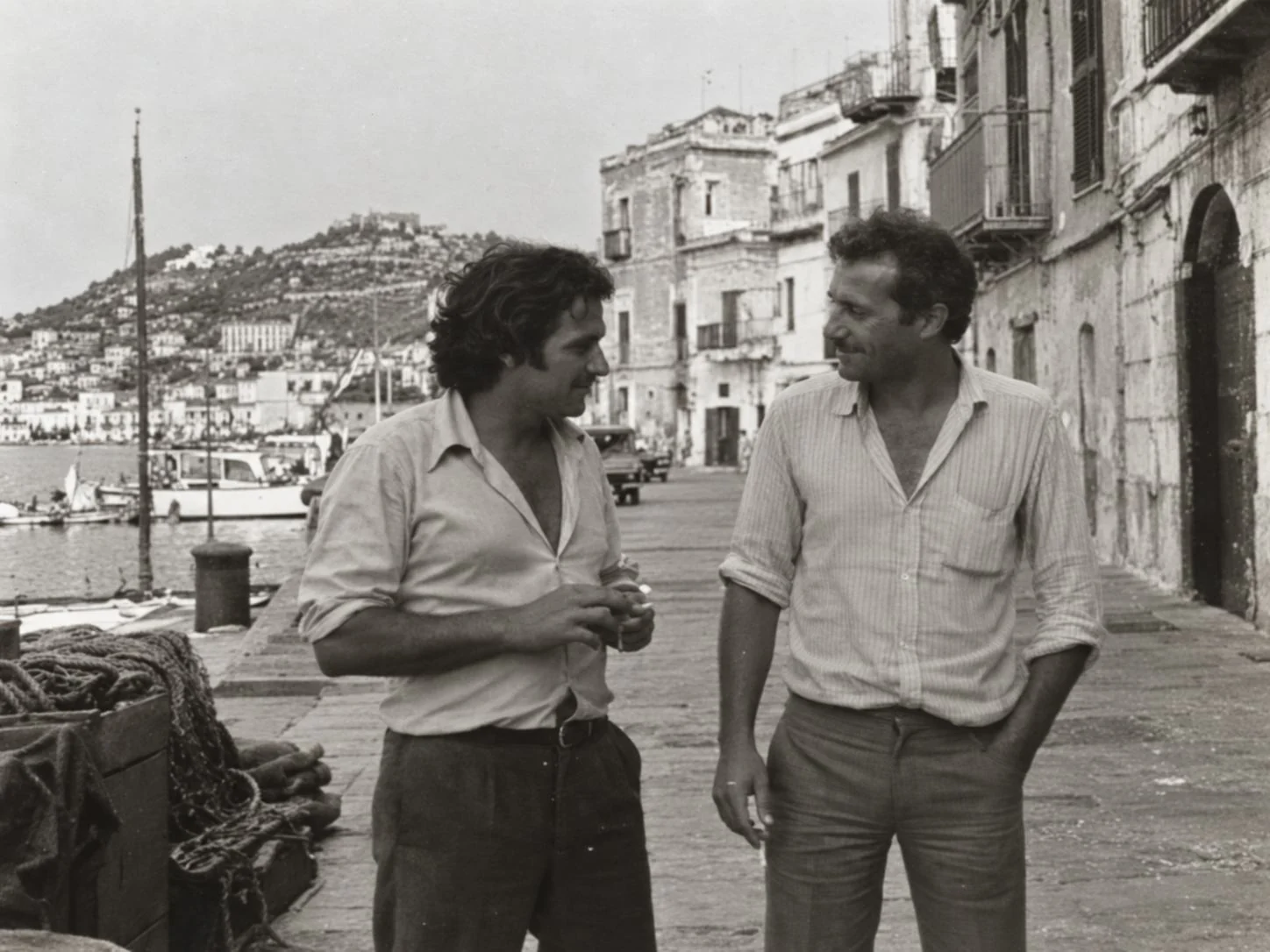
Family photographs can survive for generations. The knowledge around them is much more fragile.
- Who is standing next to your grandfather?
- Where and when was it taken?
- And who in the family might still know?
How might families preserve the context behind their memories before that context disappears?
(02) Product framing
More than a photo archive.
Tellings is a private space where families preserve not only media but the context around it: people, places, stories and the things nobody is quite sure about yet.
- 01RevisitReturn to meaningful people and memories.
- 02PreserveCapture context before it disappears.
- 03 · The core flowRecoverAsk the people who may still remember.
What families preserve, they can revisit. What is missing, they can ask about. What relatives recover returns to the Memory.
The project began with a stronger focus on memorial profiles. It moved from preserving a person to preserving context, and living relatives became sources of knowledge.
(03) Product decisions
Three decisions shape the product.
- Decision 01
A person does not need an account to matter.
Many people in a family archive will never use the app: relatives who have died, a friend in an old photo. People in the archive are kept separate from people with accounts.
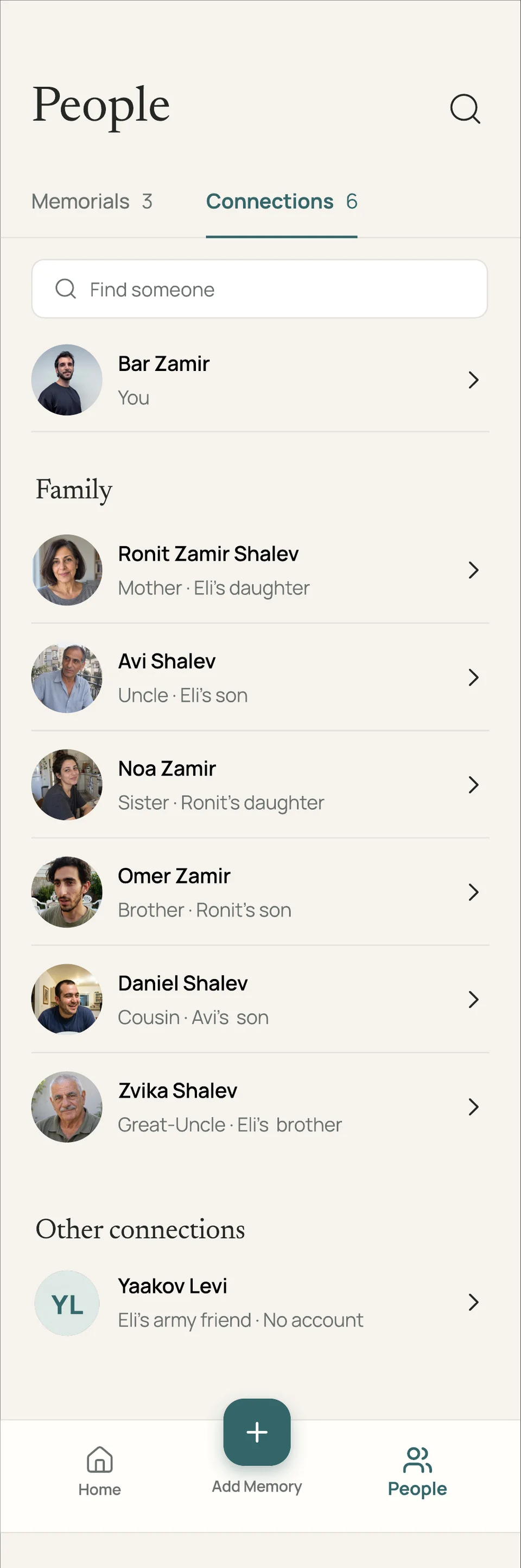
People › ConnectionsPart of the family story, with no account. - Decision 02
Incomplete information is still worth preserving.
Families rarely know every detail. Tellings saves what is known and labels what isn't, instead of forcing invented precision.
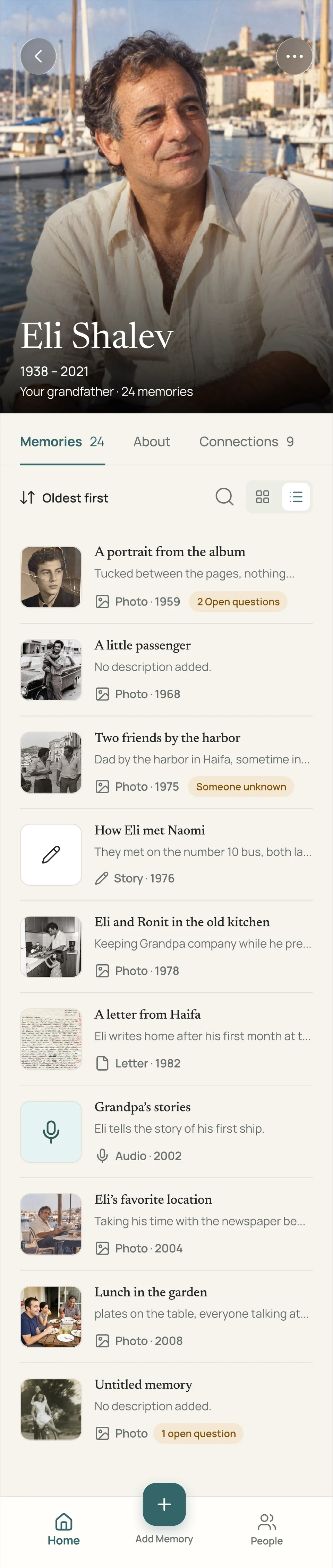
Memorial › List viewSaved without a description, or with someone unknown, and labelled. - Decision 03
Response does not equal resolution.
One answer doesn't make something true. Responses stay separate from the shared Memory, and the person who asked decides what, if anything, is added.
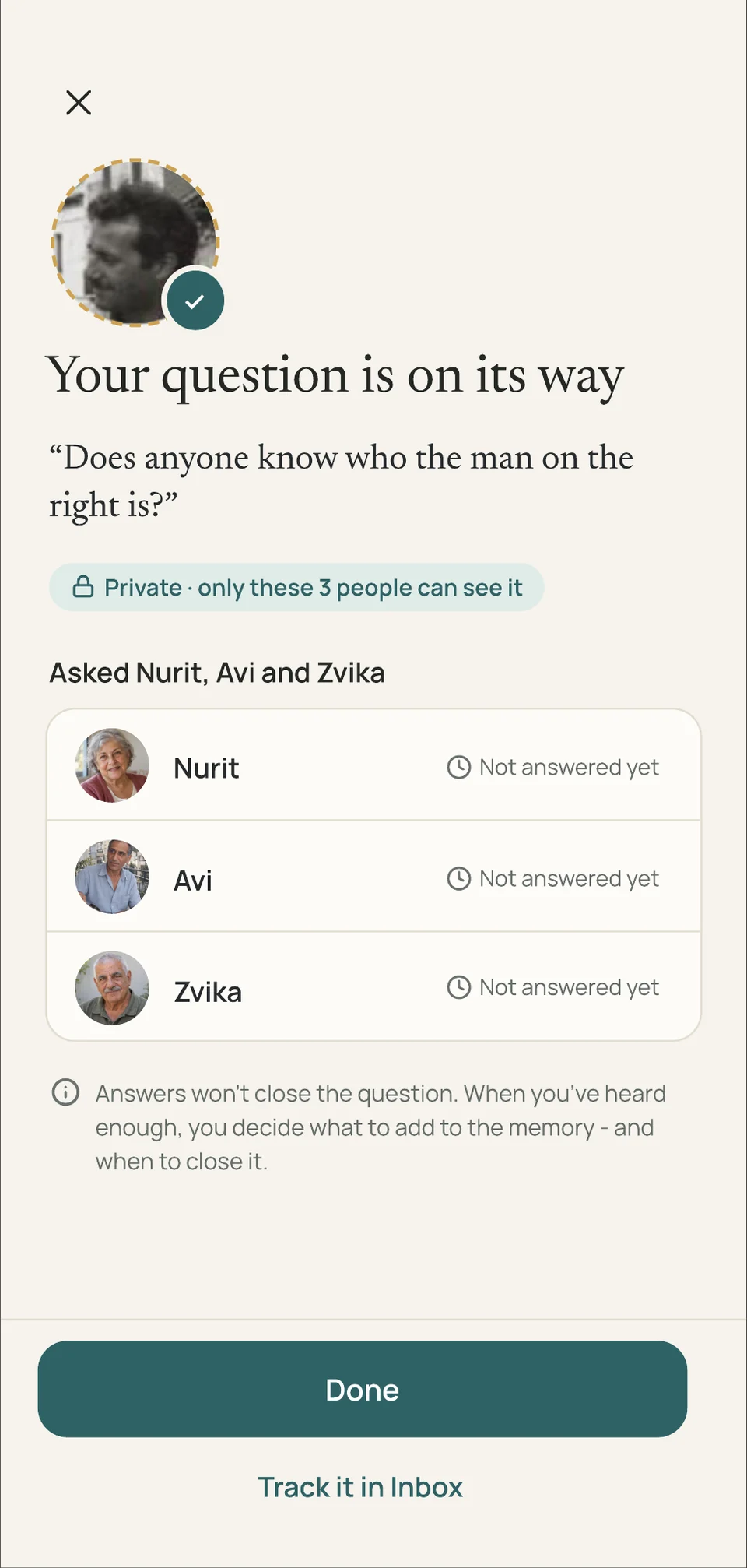
Question sentAnswers don't close a question on their own.
(04) Revisit
Return to people, not a feed.
Home brings people back to three things. No likes, counts or engagement loops.
- Memorials of people they care about
- Questions waiting for them
- Recently added memories
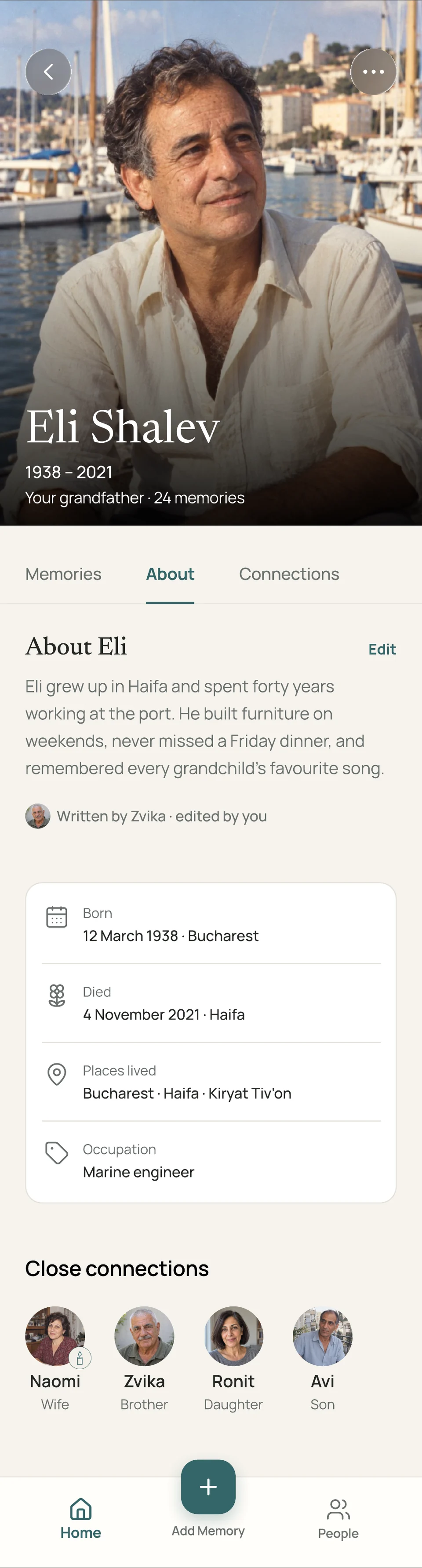
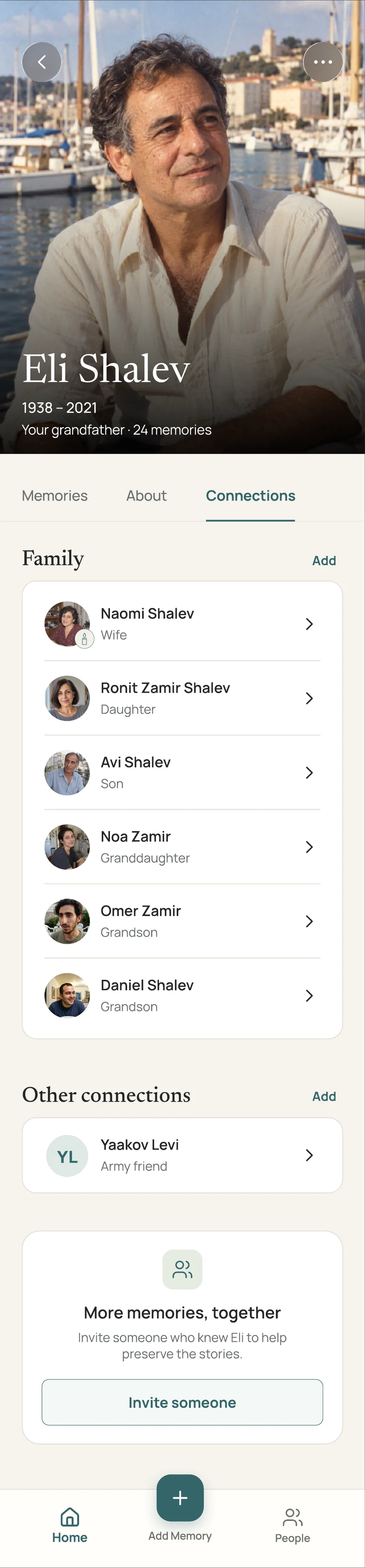
A Memorial should feel like returning to a person.
- Memories, About, Connections. One person, three views. Memories lead; About and Connections add the life around them.
(05) Preserve
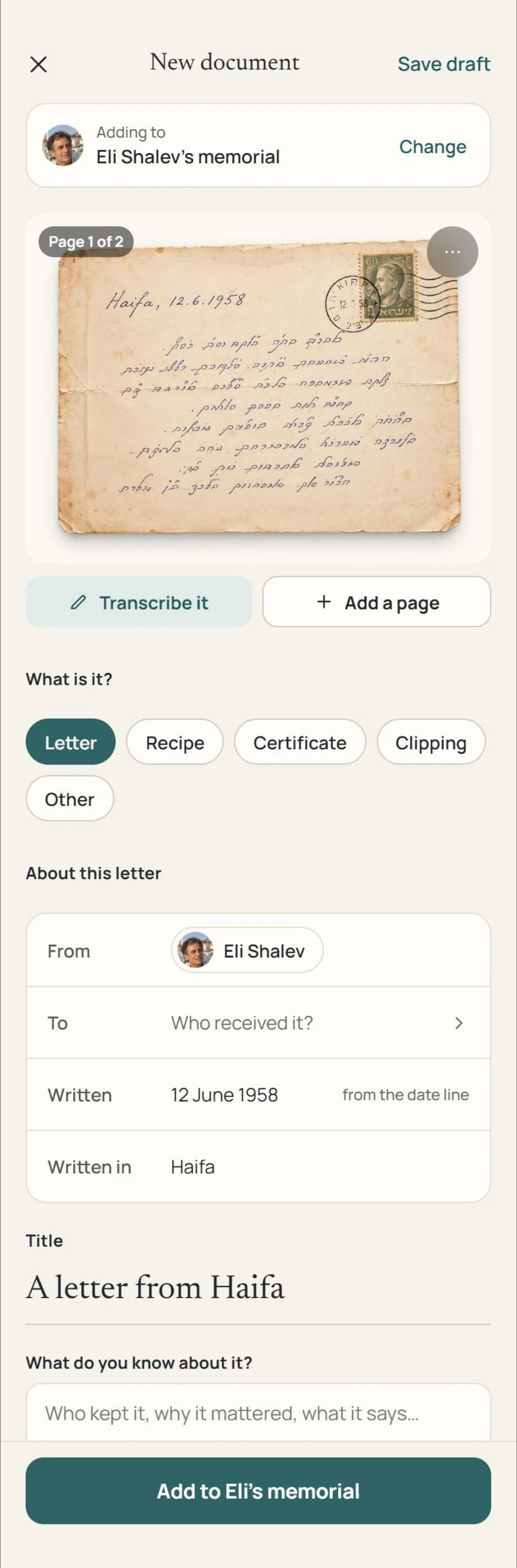
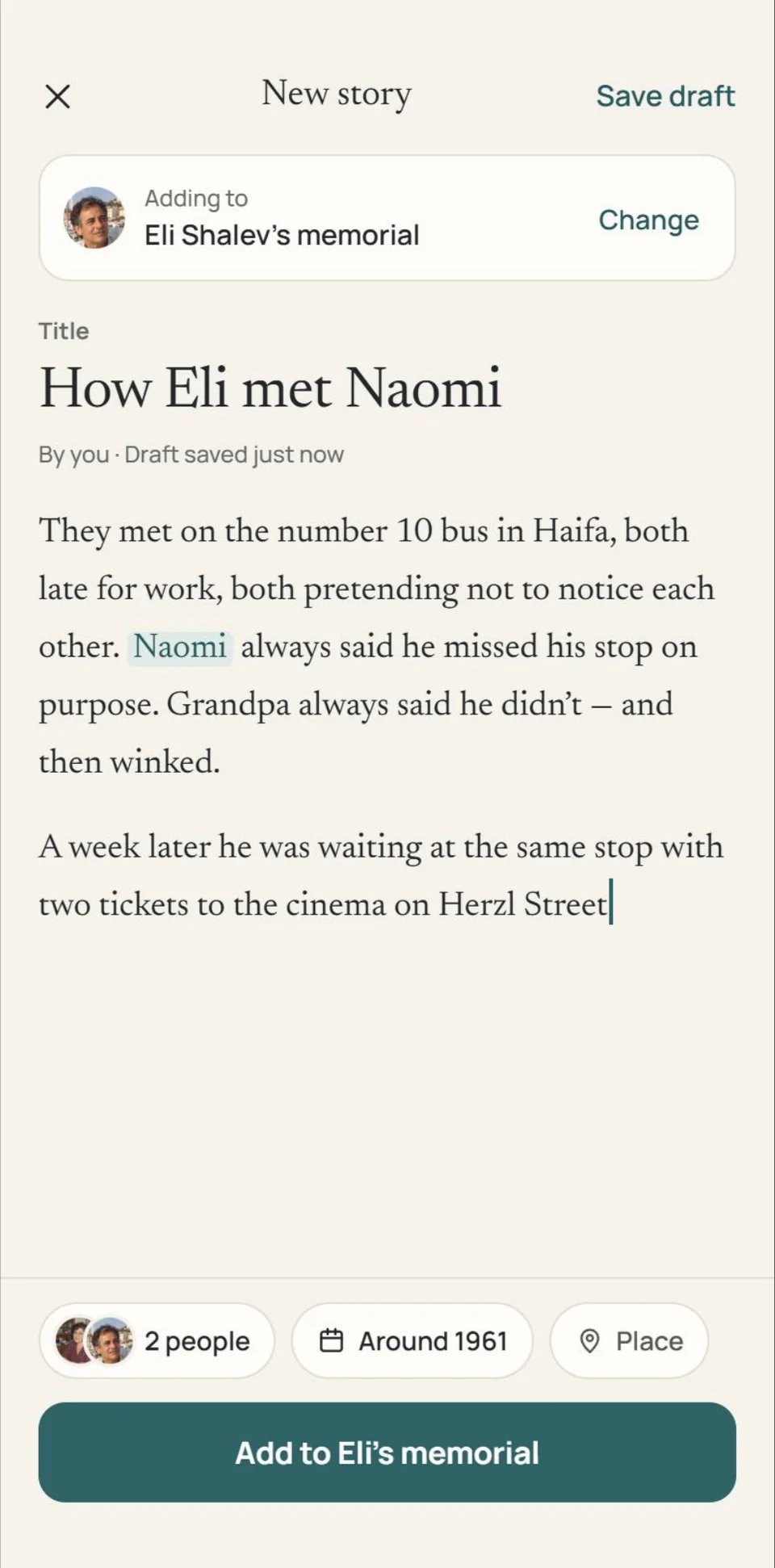
A memory isn't always a photo.
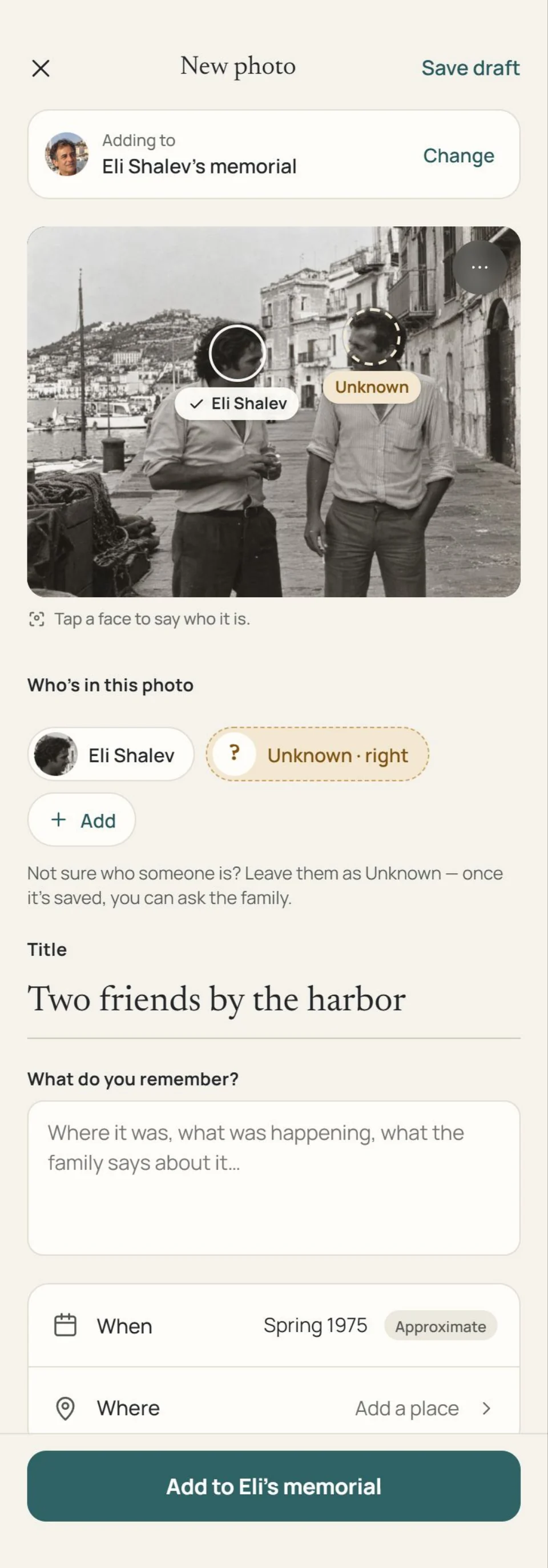
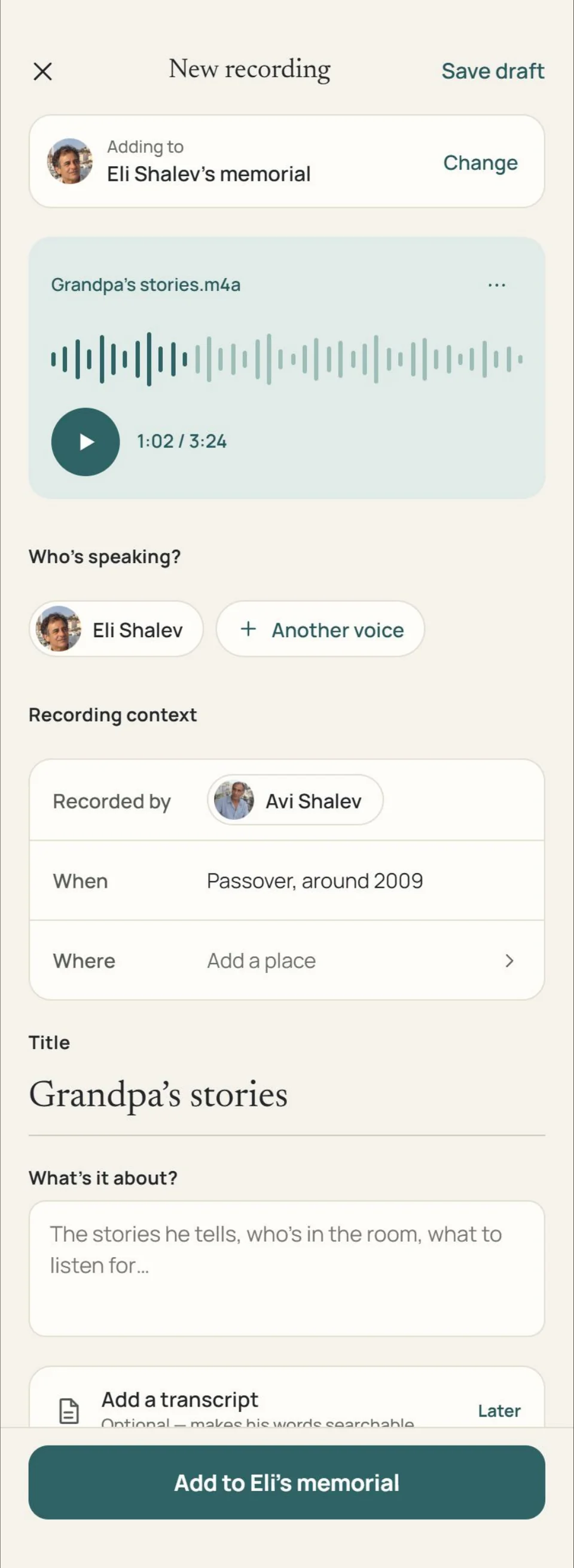
Photos, letters, recordings and stories share one creation structure. The questions change with the medium.
Same slots, different questions
- Who: “Who’s in this photo” becomes “Who’s speaking”.
- When: a season for a photo, an occasion for a recording.
- Where: optional in both.
Preserve uncertainty too.
A person can stay Unknown, a date can be Approximate, a place can wait. Gaps are saved as gaps, for the family to fill later.
(06) Preserve at scale · Build the archive
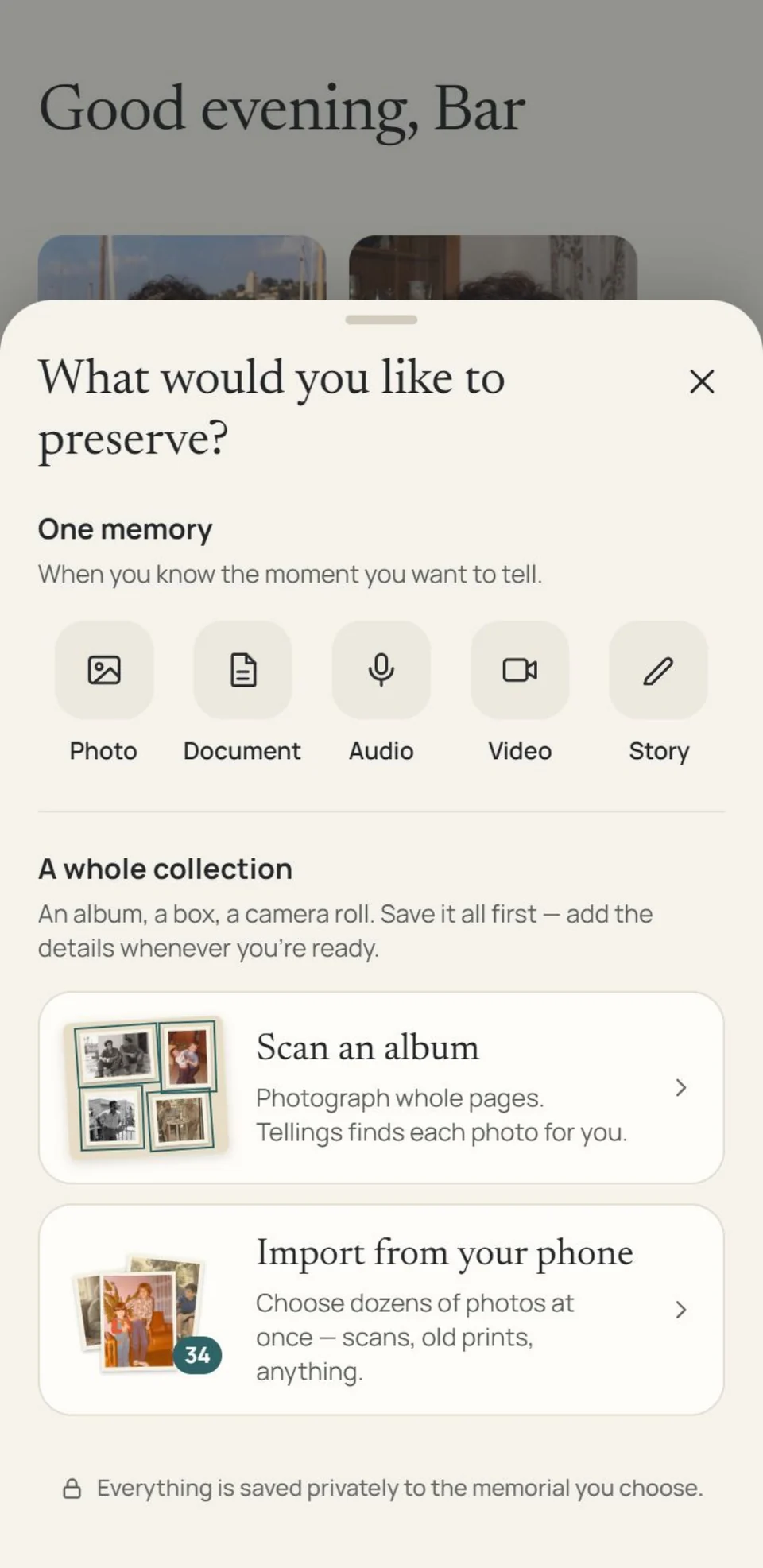
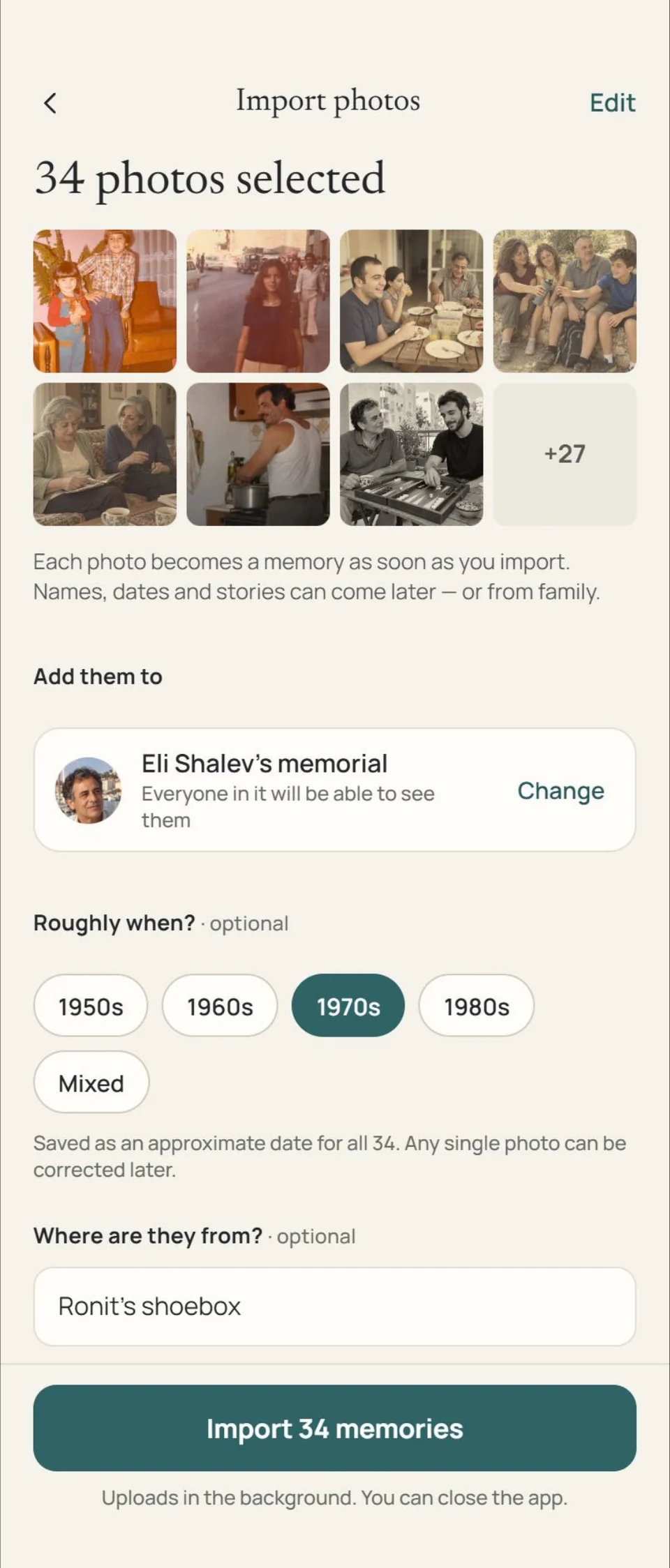
Import first. Enrich gradually.
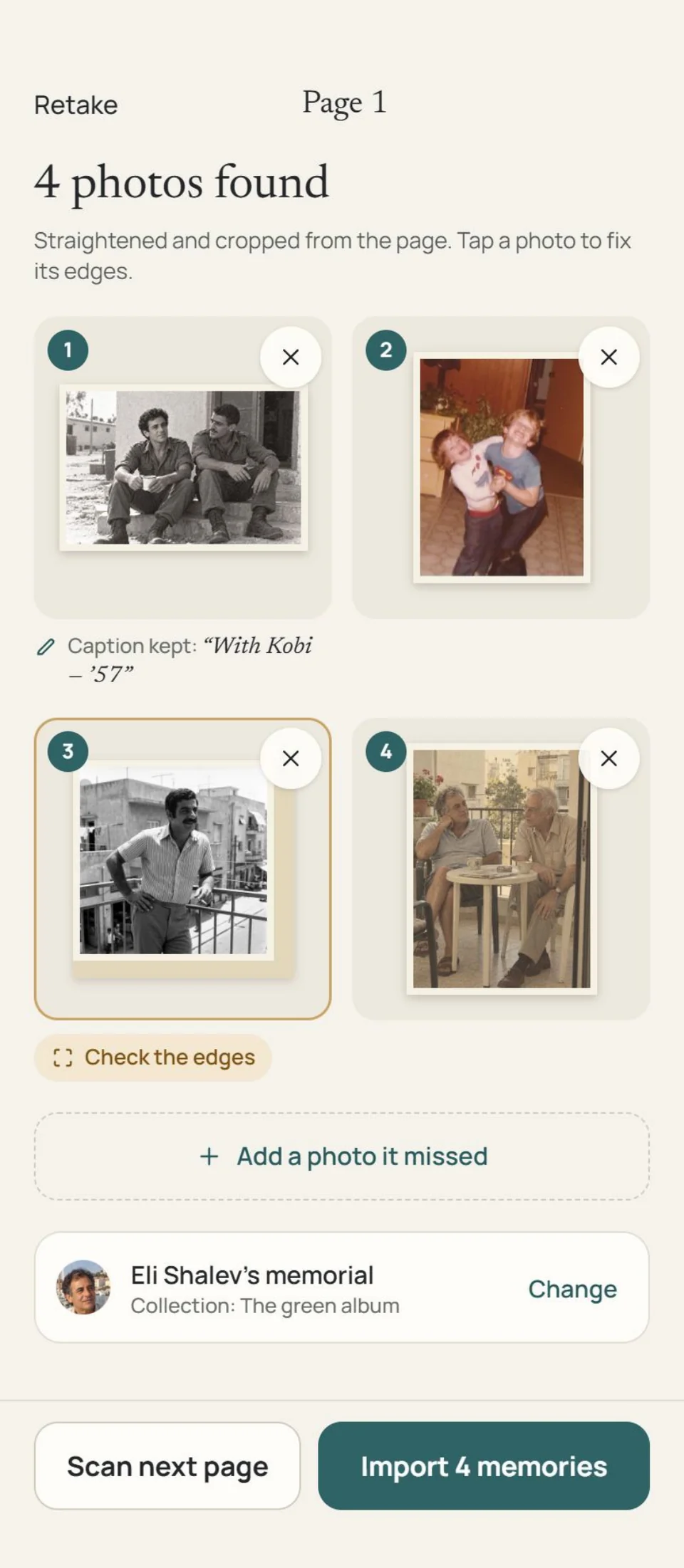
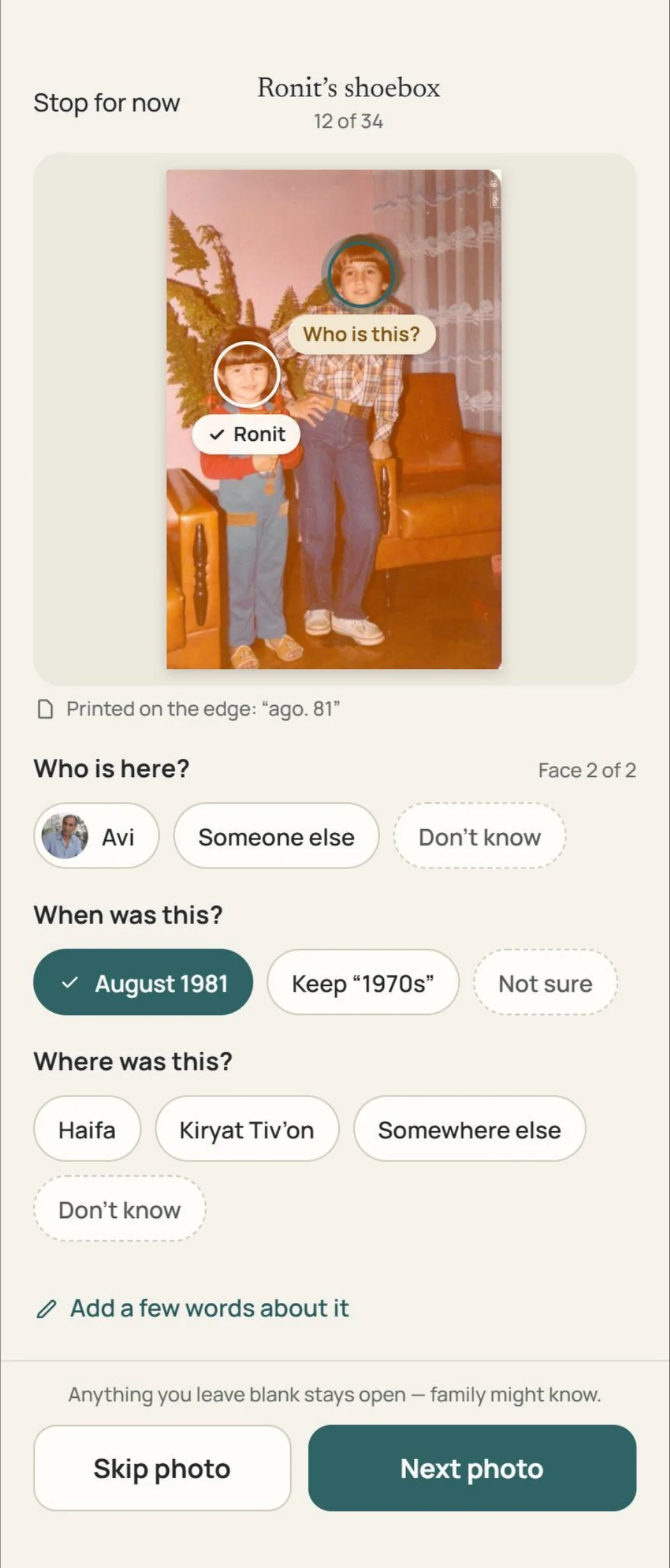
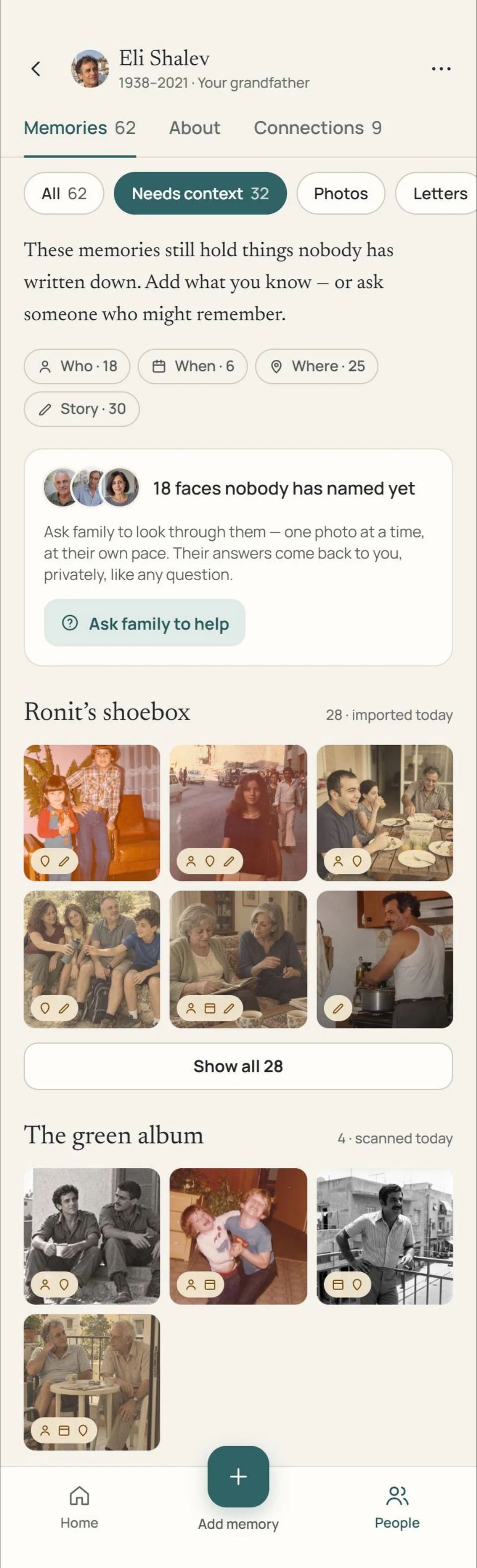
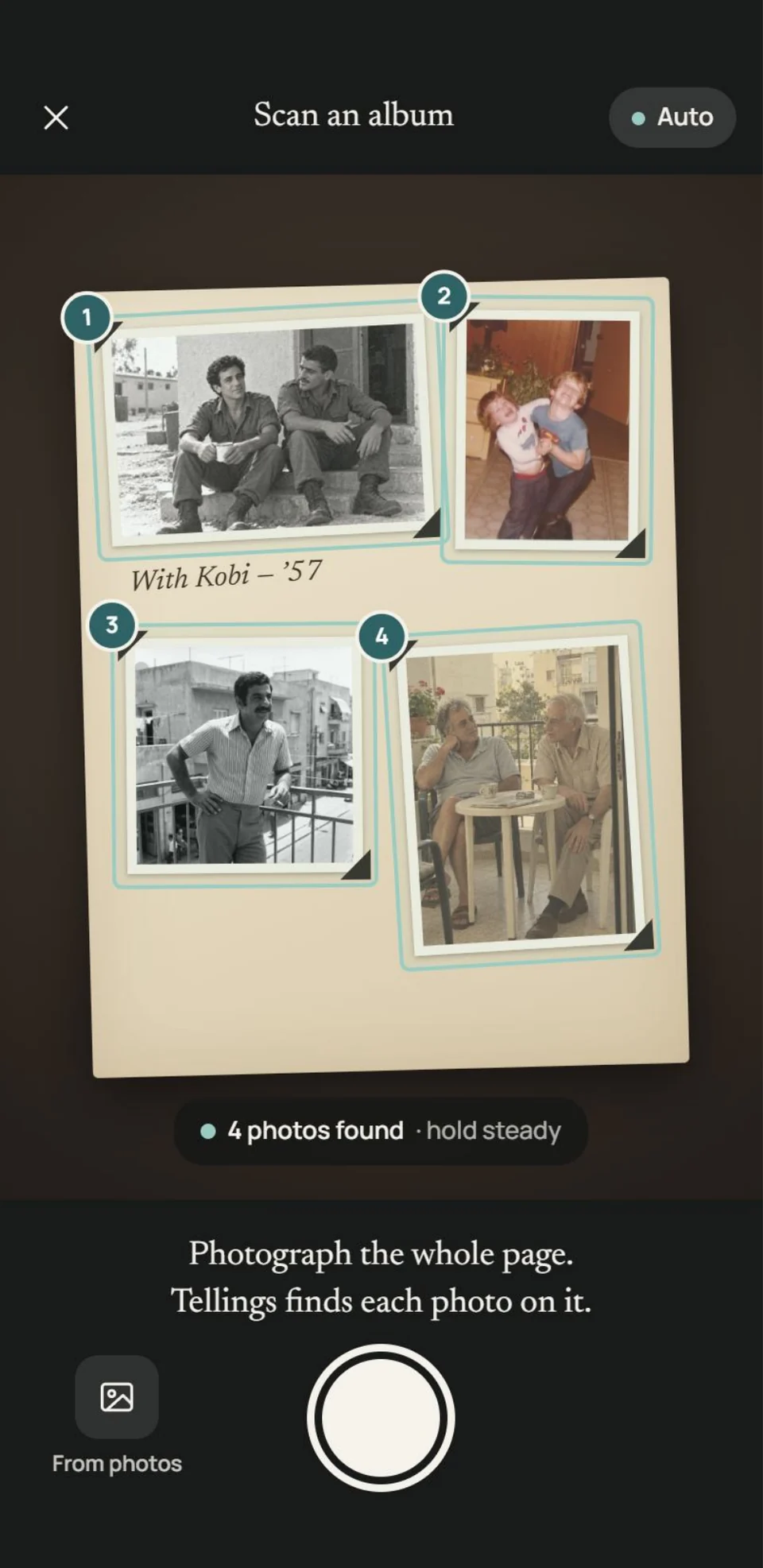
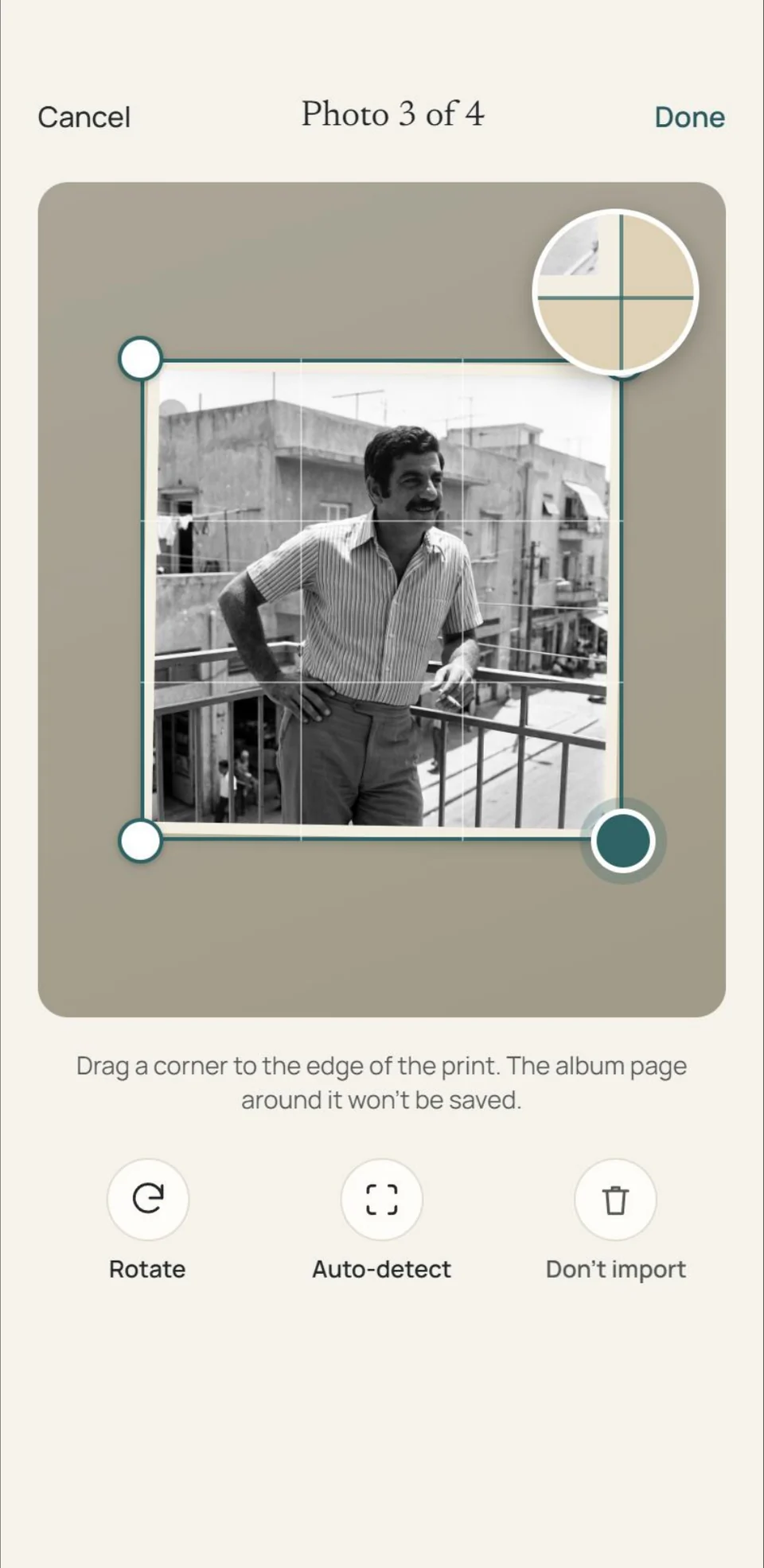
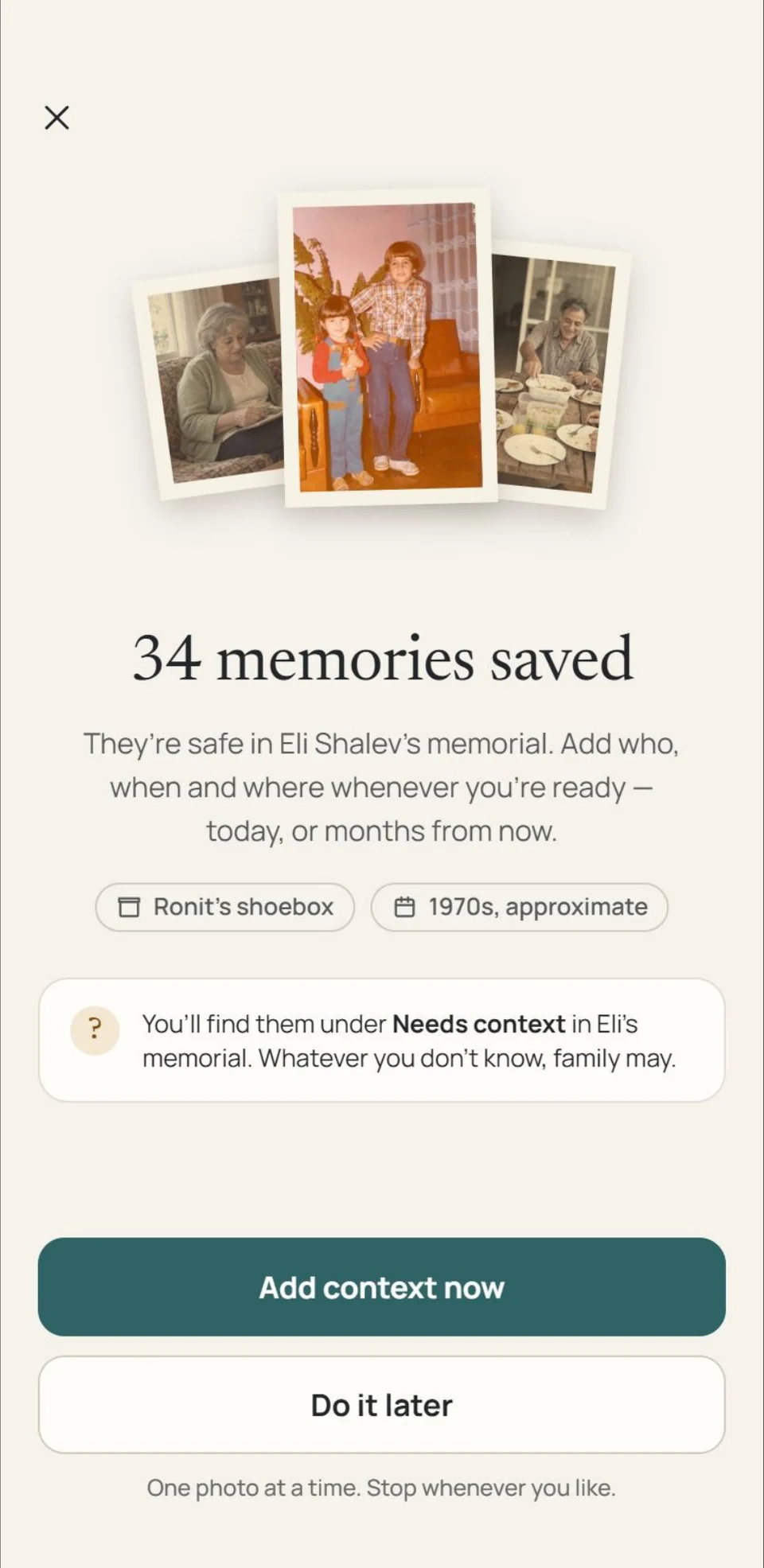
One memory starts from a moment you already know. A collection (an album, a shoebox, a camera roll) is saved first and understood later.
Preservation shouldn't feel like data entry.
Who is here? When was this? Where was this? Everything else can wait.
Also in the flow
(07) Recover · The core flow
Recover
Ask the people who may still remember.
A gap in a Memory becomes a question for the right people. Their answers can enrich the Memory without the product deciding what is true.
Step 1 · Unknown
Make missing knowledge actionable.
Eli is known; the man beside him isn’t. The gap is marked on the photo and in the people list, with a way to ask.
- “Who is this?” on the photo
- Not yet identified, with Ask who this is
Step 2 · Ask
Ask the people who might remember.
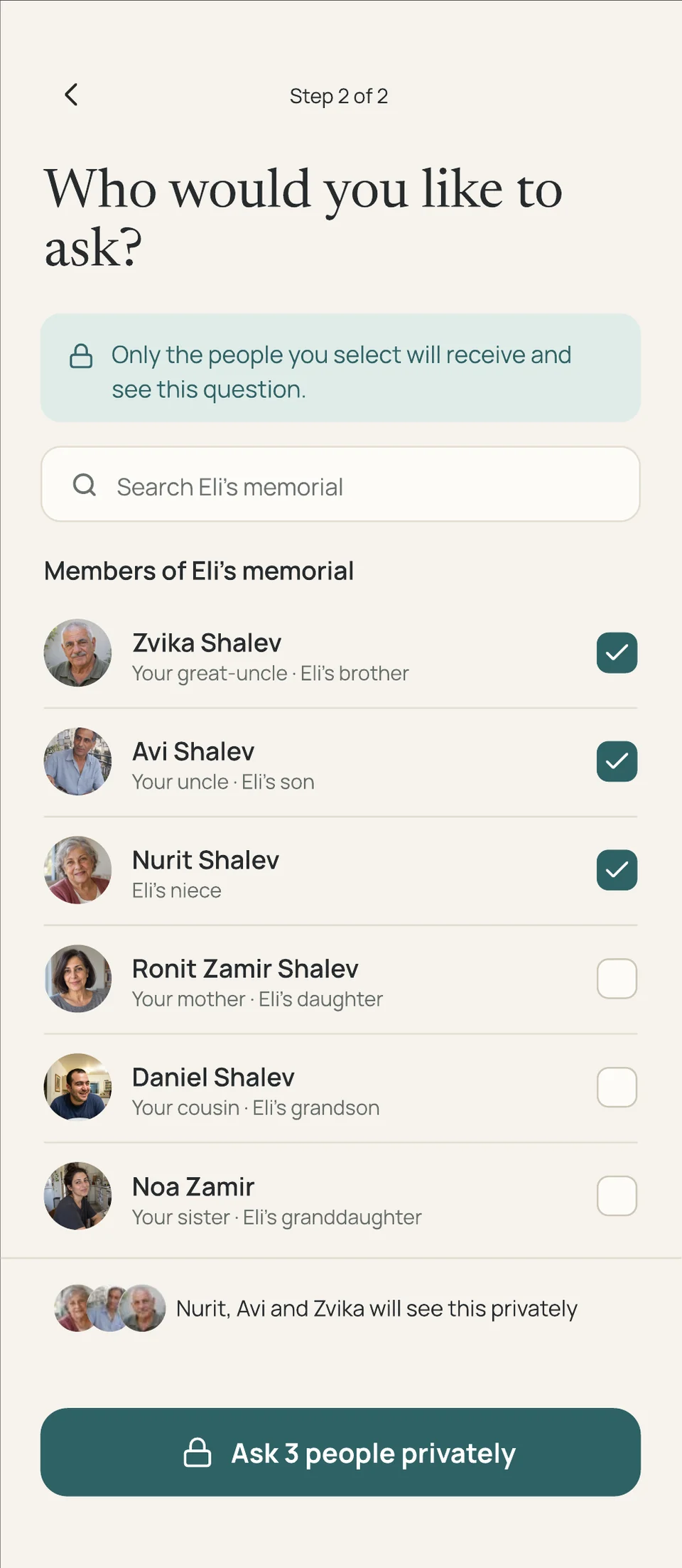
A question can go to the whole memorial, or privately to chosen people. The audience is restated at every step.
- Open: everyone in Eli’s memorial can answer.
- Targeted: only the people you choose.
- Restated above the list,
- before sending,
- and after.
Privacy is shown, not configured.
Step 3 · Perspectives
Perspectives can disagree.
“That’s Yaakov Levi.”“It might be him.”
Both answers are kept side by side, visible only to the person who asked. Neither changes the Memory by itself.
- Responses: only the requester
- A confident answer
- A less certain one
- “Nothing changes in the memory unless you add it.”
Step 4 · Update
Decide what becomes part of the Memory.
The requester writes the update in their own words.
- Who he is, from existing connections
- How he was connected to Eli
- What the family will read. Responses are never copied in.
- Who sees it. Name, tag and note go to the memorial; responses stay private.
- Closing the question is optional and reversible.
Who sees what
“Only people I choose”
“Only you can see these”
“Everyone in Eli’s memorial will see the name, the tag and your note.”
Step 5 · Recovered
Unknown → Known
The Recover experience does not end when a question is closed. It ends when the Memory becomes richer.
- Unknown
- Ask
- Perspectives
- Update
- Richer memory
(08) Product restraint
Less activity. More intention.
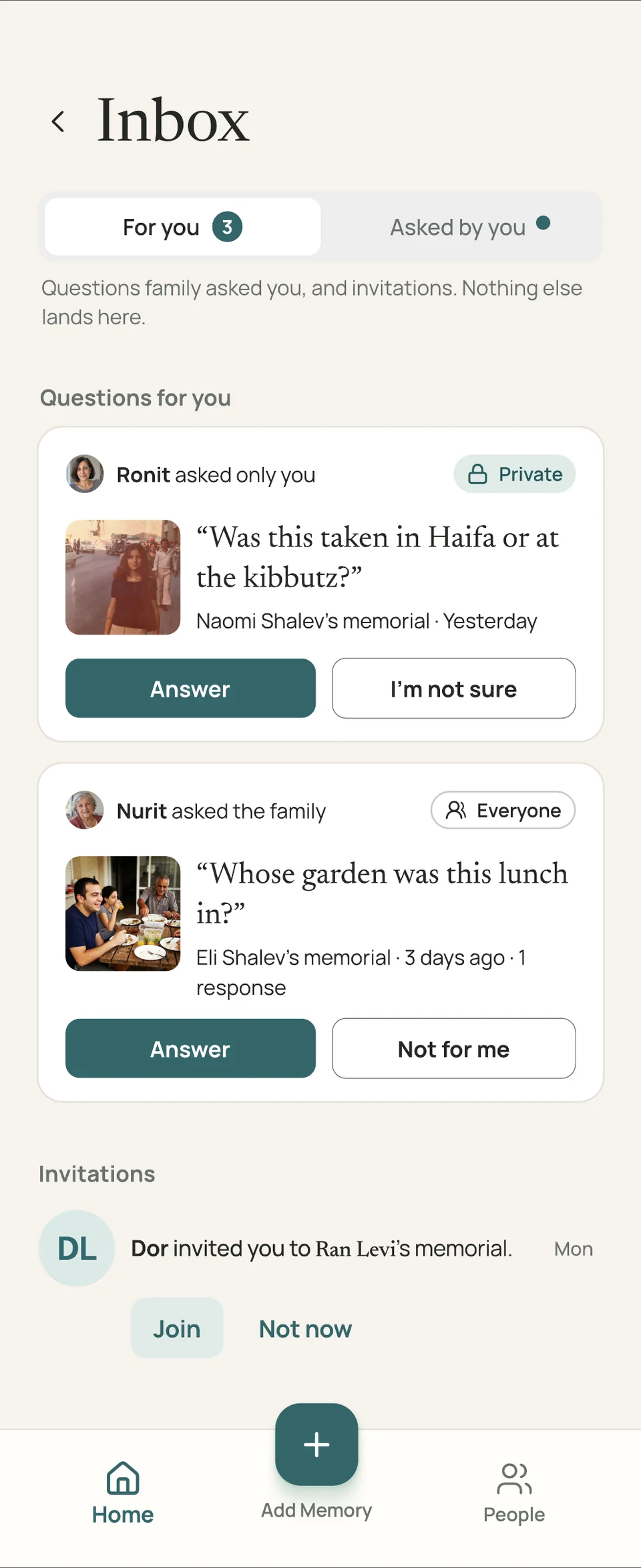
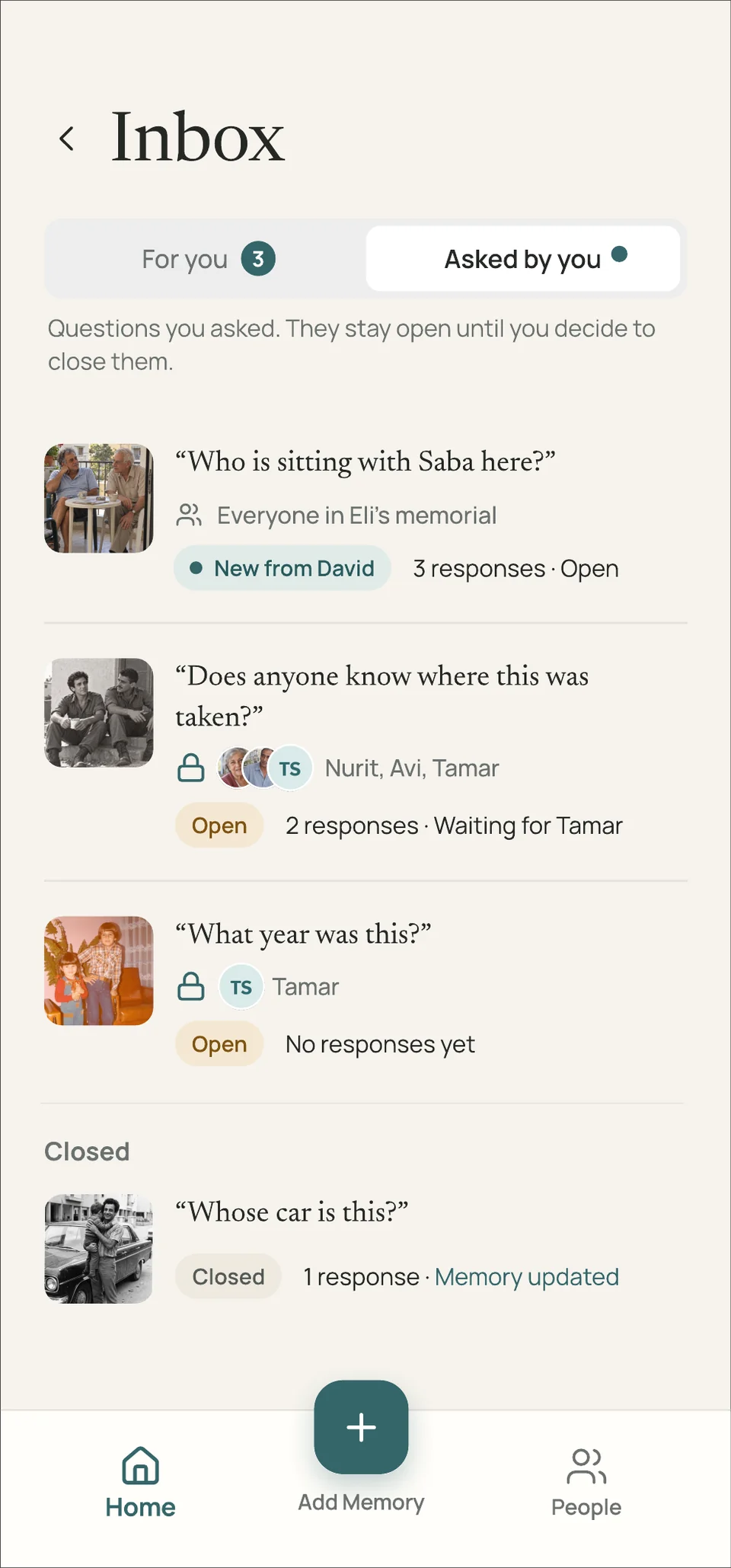
Inbox holds only what needs attention.
- For you
- Questions family asked you, and invitations.
- Asked by you
- Questions you're tracking. They stay open until you close them.
A general Updates feed was removed. Home already shows new memories; Inbox is for what needs action.
(09) Visual language
Quiet around the memory.
A restrained interface lets family media carry the emotion.
Photos run edge to edge; the interface steps back.
Newsreader for what the family wrote. Manrope for navigation, metadata and actions.
One teal for actions and confirmed states, on warm and neutral surfaces.
Amber: open or unknown. Teal: private or identified. Grey: closed or approximate.
(10) The product
At a glance.
Revisit · Preserve · Recover
(11) Reflection
The most important shift was realizing that the system should not become the authority on a family's history.
Tellings can collect what relatives remember and show what is uncertain. Deciding what is true stays with the family.
What I would validate next
Open questions. None has been tested with families yet.
- 01 · Targeted questionsDo people understand who can see a targeted question?
- 02 · Conflicting answersHow do families interpret probable or conflicting identifications?
- 03 · Archive buildingDoes progressive enrichment reduce the burden of preserving a large collection?